
The period after embryo transfer can be one of the most emotional stages of an IVF journey. Symptoms after embryo transfer day by day may include mild cramping, spotting, fatigue, or breast tenderness as the embryo develops and implantation begins. However, they can vary widely, and many successful pregnancies occur without any noticeable signs. Understanding what happens during the IVF two-week wait can help you reduce anxiety and set realistic expectations until pregnancy can be confirmed through a Beta hCG test.
After IVF if you wake up feeling a little cramp, twinge, spotting or mild fatigue in your body, then it could be a sign that your embryo transfer worked.
For many couples undergoing IVF, the days after embryo transfer can feel like the longest part of the entire journey. You may find yourself searching for answers, comparing symptoms online, or wondering whether the absence of symptoms means something is wrong.
The truth is that the period between embryo transfer and pregnancy testing, often called the IVF two week wait timeline, can be emotionally challenging. Every day brings new questions, and every sensation can feel significant.
Dr. Swati Singh (Reproductive Medicine Specialist, MBBS, MD, DNB, FRM, DRM) at Yaami IVF & Fertility Centre, Indore, explains that while some women experience noticeable changes after embryo transfer, many successful pregnancies begin with very few or even no symptoms at all. This is why understanding what is actually happening inside the uterus can be more helpful than trying to interpret every physical sensation.
In this blog, we will walk through the symptoms after embryo transfer day by day and help you understand when it’s finally time to take your pregnancy test.
What is Embryo Transfer in IVF?
Embryo transfer is one of the final and most important steps in the IVF process.
After eggs are collected and fertilized in the laboratory, the resulting embryos are carefully monitored by embryologists. The healthiest embryo is then placed into the uterus using a thin catheter.

This procedure itself is usually quick, painless, and does not require surgery.
However, while the transfer may only take a few minutes, the biological processes that follow are much more complex. The embryo still needs to attach to the uterine lining and continue developing successfully.
This is why the days which are following embryo transfer are so important.
To better understand the process, let’s look at what typically happens inside the uterus during the days after transfer.
The Cellular Timeline: What Happens Inside the Uterus After Transfer
Many people focus only on external symptoms, but the most important events are actually happening at a microscopic level.
Understanding this timeline can help you reduce anxiety and provide a clearer picture of what your body may be experiencing.
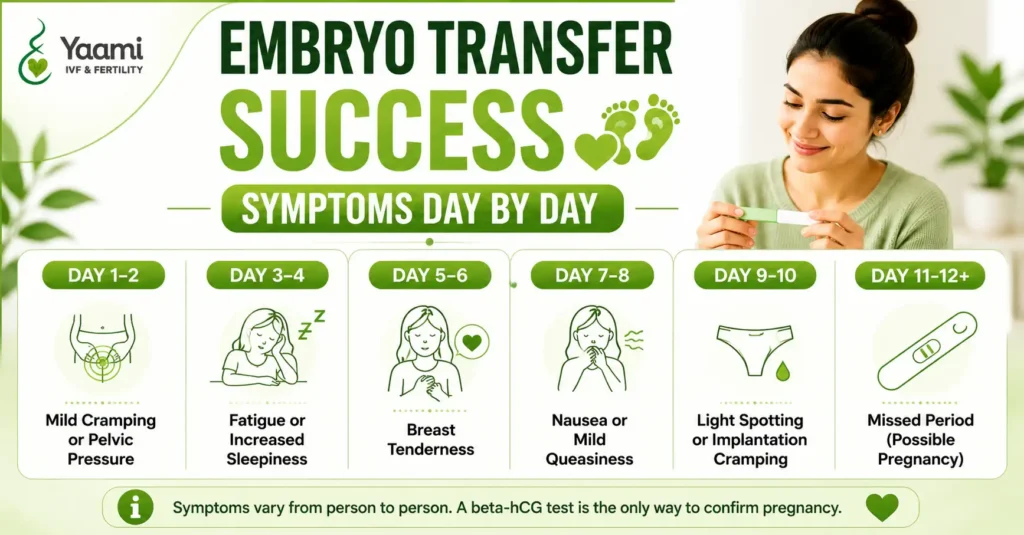
Days 1 to 3: Hatching and Apposition
During the first few days after transfer, the embryo begins preparing for implantation.
If a blastocyst embryo was transferred, it starts a process called hatching. This means the embryo breaks free from its outer shell so that it can interact directly with the uterine lining.
At this stage:
- The embryo is searching for the ideal implantation site.
- The uterus continues preparing a supportive environment.
- Hormonal support helps maintain the endometrial lining.
Possible symptoms during Days 1 to 3 may include:
- Mild cramping
- Light bloating
- Fatigue
- No symptoms at all
It’s important to remember that these sensations can be caused by medications as well, so they should not be considered definite signs of successful embryo implantation.
However, this is only the beginning of the process.
Days 4 to 6: Deep Implantation into the Endometrial Lining
This stage is often considered one of the most critical periods of implantation.
The embryo begins attaching more firmly to the endometrial lining and establishing an early connection with the mother’s blood supply.
During this time:
- Implantation becomes deeper.
- Coordination between the embryo and uterus increases.
- Early pregnancy-related biological changes may begin.
Some women may notice:
- Mild pelvic discomfort
- Light spotting (sometimes called implantation spotting)
- Increased tiredness
However, many women experience none of these symptoms and still go on to healthy pregnancies.
Days 7 to 11: hCG Hormone Production Begins
Once implantation is established, the developing embryo starts producing Human Chorionic Gonadotropin (hCG).
This hormone is responsible for maintaining early pregnancy and this hormone is detected by pregnancy tests.
During this stage:
- hCG levels gradually rise.
- Pregnancy-related hormonal changes begin.
- The body starts adapting to the developing pregnancy.
Possible symptoms may include:
- Increased fatigue
- Breast sensitivity
- Mood changes
- Frequent urination
- Mild cramping
Common Symptoms vs. Medication Side Effects (Progesterone Support)
After embryo transfer, most women take progesterone to support implantation and early pregnancy. The challenge is that progesterone can cause symptoms that look very similar to early pregnancy symptoms.
| Symptom | Could Be Implantation | Could Be Progesterone |
| Mild cramping | ✓ | ✓ |
| Breast tenderness | ✓ | ✓ |
| Fatigue | ✓ | ✓ |
| Bloating | Sometimes | ✓ |
| Mood swings | Sometimes | ✓ |
| Increased vaginal discharge | Sometimes | ✓ |
| Mild nausea | ✓ | Sometimes |
The Key Thing to Remember
Many symptoms overlap, which means they are not reliable signs of success or failure.
- Having symptoms does not guarantee pregnancy.
- Having no symptoms does not mean the cycle has failed.
- Progesterone can create many of the same feelings as early pregnancy.
This is why fertility specialists recommend focusing less on symptoms and waiting for the Beta hCG blood test, which is the only reliable way to confirm whether implantation has occurred.
Why a Lack of Symptoms Does Not Mean a Failed Cycle
One of the biggest myths during the IVF two week wait timeline is that successful implantation always causes noticeable symptoms.
This simply isn’t true.
Many women who later receive a positive pregnancy test report experiencing:
- No cramps
- No spotting
- No breast tenderness
- No nausea
- No obvious pregnancy symptoms
The reason is simple.
Implantation happens at a microscopic level. Your body does not always produce noticeable physical signs immediately.
In fact, some women experience more symptoms during unsuccessful cycles because of progesterone medications than they do during successful pregnancies.
Dr. Swati Singh often reminds patients that symptom tracking cannot accurately predict IVF success.
The only reliable way to confirm whether implantation has occurred is through a properly timed pregnancy test.
This brings us to the final and most important step of the journey.
The Final Step: When to Safely Take the Beta hCG Blood Test
After spending days on analyzing every possible symptom, most patients reach a point where they simply want a clear answer.
The Beta hCG blood test is the most accurate way to determine whether pregnancy has occurred after IVF.
In most cases:
| Days After Transfer | What is Happening? |
| Days 1–3 | Embryo hatching and positioning |
| Days 4–6 | Implantation process begins |
| Days 7–11 | hCG hormone production starts |
| Days 10–14 | hCG levels continue rising |
| Around Day 12–14 | Beta hCG blood test recommended |
Taking a home pregnancy test too early can lead to confusion.
This may happen because:
- hCG levels are still too low to detect.
- Trigger injections may affect results.
- False negatives may occur.
For this reason, fertility specialists usually recommend waiting until the scheduled Beta hCG blood test date.
While the wait can feel difficult, testing too early often creates more stress than reassurance.
Conclusion
The days after embryo transfer can be filled with hope, excitement, and uncertainty. While many women search for symptoms after embryo transfer day by day, it is important to remember that every IVF journey is unique.
Some women experience several possible signs of successful embryo implantation, while others notice almost nothing at all. Both experiences can be completely normal. Understanding the IVF two week wait timeline can help you focus on what is actually happening inside your body rather than worrying about every symptom or lack of symptoms.
At Yaami IVF & Fertility Centre, Indore, our experienced fertility specialists guide patients through every stage of the IVF journey with evidence-based care, advanced embryology support, and compassionate counseling. Whether you’re preparing for embryo transfer or waiting for your Beta hCG results, our team is here to support you every step of the way.

Dr. Swati Singh (MBBS, MD – Obstetrics & Gynecology, DNB, FRM, Diploma in Reproductive Medicine and Embryology – Germany) is a leading Infertility Specialist and Gynecologist with over 18 years of experience. As Co-Founder and Senior Consultant at Yaami Fertility & IVF Center, Indore, she offers advanced fertility care including IUI, IVF, ICSI, and management of female reproductive disorders. Known for her compassionate and patient-first approach, Dr. Swati combines global training with deep clinical expertise. She is also actively involved in women’s health advocacy, medical research, and promoting awareness about reproductive wellness and fertility treatments.