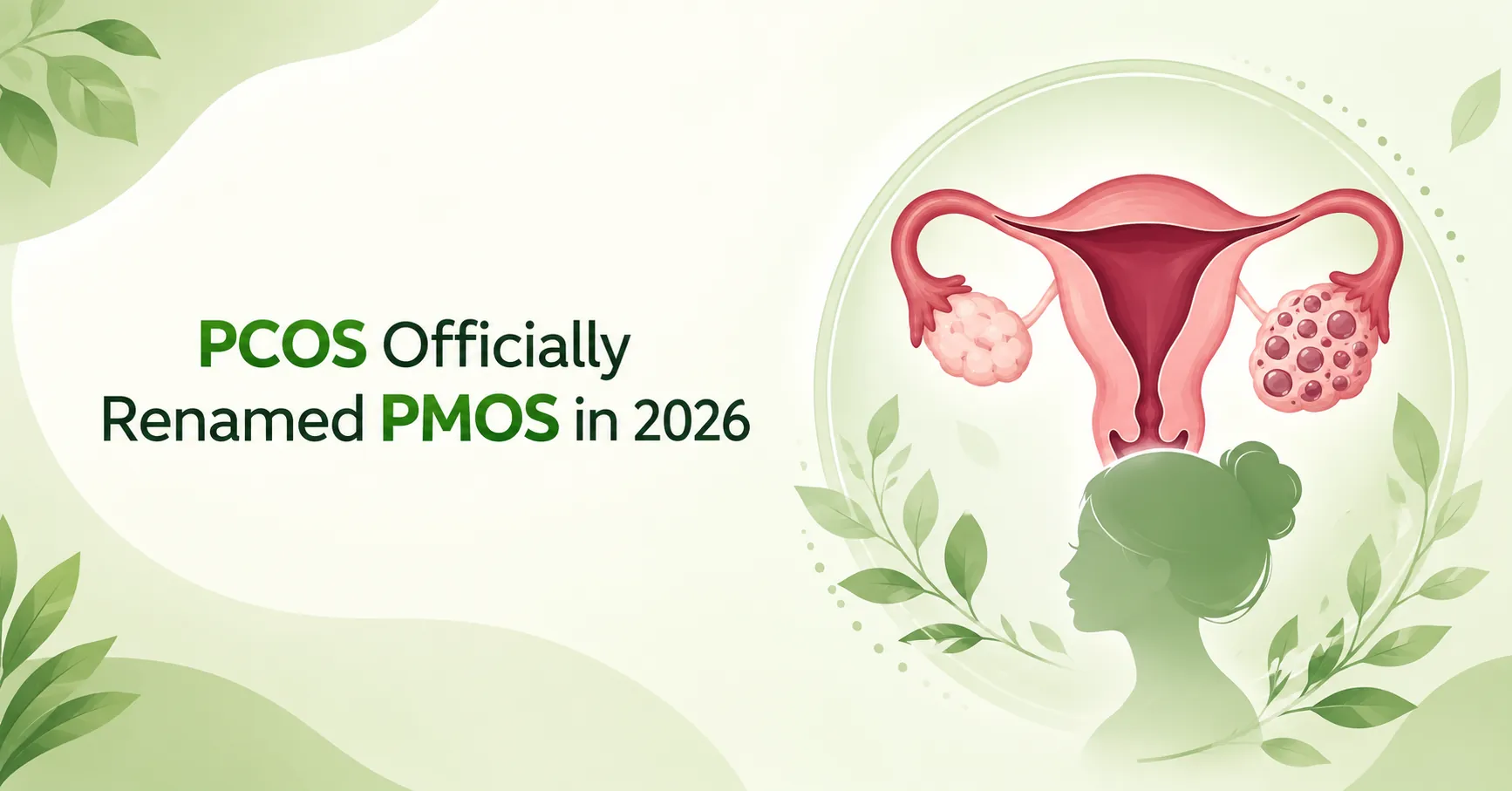
PCOS officially renamed PMOS (Polyendocrine Metabolic Ovarian Syndrome) in 2026. This change was made because the older name did not accurately reflect the full complexity of the condition. PMOS better represents that it is not just an ovarian disorder, but a condition involving hormonal, metabolic, and reproductive health. PMOS symptoms go beyond irregular periods and ovarian cysts. It may also involve insulin resistance, weight gain, acne, excessive hair growth, fertility issues, fatigue, mood swings, and metabolic complications. Although the name has changed, the core treatment approach remains similar, including lifestyle management, weight control, hormone balancing, insulin resistance management, and fertility support. The new name simply helps doctors and patients better understand the condition as a whole-body hormonal and metabolic disorder rather than only an ovarian problem.
If you have been living with a PCOS diagnosis, managing your PCOS symptoms, tracking your cycles, adjusting your diet, and trying to conceive, you may have seen the news this week and felt a little confused after knowing that PCOS new name is PMOS.
Now, you must be getting a lot of questions in your mind, like, What does that mean for you? Does your diagnosis change? Do you need new tests? Will your treatment plan shift? Etc, etc. So, to be honest, your diagnosis is still valid, and your treatment doesn’t change overnight.
As recently published in The Lancet, an international consensus has led to PCOS renamed PMOS 2026. This landmark shift emphasizes that the condition is a lifelong, multisystem disorder. Research also highlights that the transition to Polyendocrine Metabolic Ovarian Syndrome (PMOS) is necessary to better reflect the complex interplay between reproductive health and metabolic risks, such as type 2 diabetes and cardiovascular health, which affect millions of women globally.
According to Dr Swati Singh (Reproductive Medicine), MBBS, MD, DNB, FRM, DRM (Germany) at Yaami IVF and Fertility Centre, Indore, the PCOS renamed PMOS shift is one of the most significant moments in women’s health in decades, not because the condition itself has changed, but because medicine has finally caught up with what your body has been trying to tell you all along.
So, to help you understand better, we will break down everything in this blog simply and clearly.
What Is PMOS?
PMOS stands for Polyendocrine Metabolic Ovarian Syndrome. It is the new official name for the condition you may have known as PCOS (Polycystic Ovary Syndrome).
On 12 May 2026, the new name was formally announced at the European Congress of Endocrinology in Prague and published in The Lancet, one of the most respected medical journals in the world. Over 56 patient and professional organisations from across the globe were part of this process, including the Endocrine Society.

The condition itself hasn’t changed. What has changed is the name and with it, the way the medical world understands, diagnoses, and treats it. If you have PCOS, you now have PMOS. Same person, same body, same hormonal patterns. Just a far more accurate label.
Why Did PCOS Need Renaming?
For years, the name Polycystic Ovary Syndrome was considered inappropriate by the medical community. Many women were told they had cysts on their ovaries, leading to unnecessary fear of surgery, while others who had the hormonal symptoms but clear ultrasounds were often dismissed. So, to make it easy to understand the name has to be clear and not only this there are many other reasons for PCOS renaming, like:
- The Cyst Confusion: Many women do not have cysts; rather they have a high number of small follicles that have not matured.
- Missing the Big Picture: The old name ignored the metabolic side, like insulin resistance, which affects your weight, skin, and long-term health.
- Stigma: Shifting the focus helps society understand this as a complex hormonal imbalance rather than just a reproductive issue.
The Global Process Behind the Name Change
This was not a one-day decision. The journey to the new PCOS name took 14 years and involved the most extensive disease-renaming process in women’s medical history. It started in 2015, when a group of international experts met to agree that the old name was medically inaccurate. What followed was a decade of rigorous surveys, workshops, and global consultations supported by 56 leading academic, clinical, and patient organizations.
By May 2026, an international team led by endocrinologist Professor Helena Teede at Monash University compiled data from more than 14,000 patients alongside doctors, researchers, patient advocacy groups, and charitable organisations across multiple countries. They asked what people wanted the new name to do. Three final name candidates were tested in workshops with participants from every continent and every interest group. Finally, PMOS was the winner.
The result was published in The Lancet on 12 May 2026 and presented the same day at the European Congress of Endocrinology. To allow health systems, electronic medical records, and other medical organizations enough time to transition seamlessly, the two names PCOS and PMOS will remain interchangeable for a three-year implementation window before full adoption takes effect in 2028.
Breaking Down PMOS — What Each Word Means
The new name is actually a description of the condition. Let’s look at what each word tells you:
- Polyendocrine
Poly means many, and endocrine refers to your glands and hormones. This acknowledges that it’s not just about estrogen or progesterone; it involves insulin, cortisol, and androgens (like testosterone) working together.
- Metabolic
This is a crucial addition. It highlights how your body converts food into energy. Most women with this condition face insulin resistance, which is why you might find it difficult to lose weight or why you experience intense sugar cravings.
- Ovarian
The ovaries remain a central part of the diagnosis, as they are often the site where the hormonal imbalance manifests, affecting ovulation and your cycle.
- Syndrome
A syndrome is a collection of symptoms. It means that no two women experience PMOS in exactly the same way. Your journey is unique to you.
PMOS Symptoms: The Full Picture Beyond Ovaries
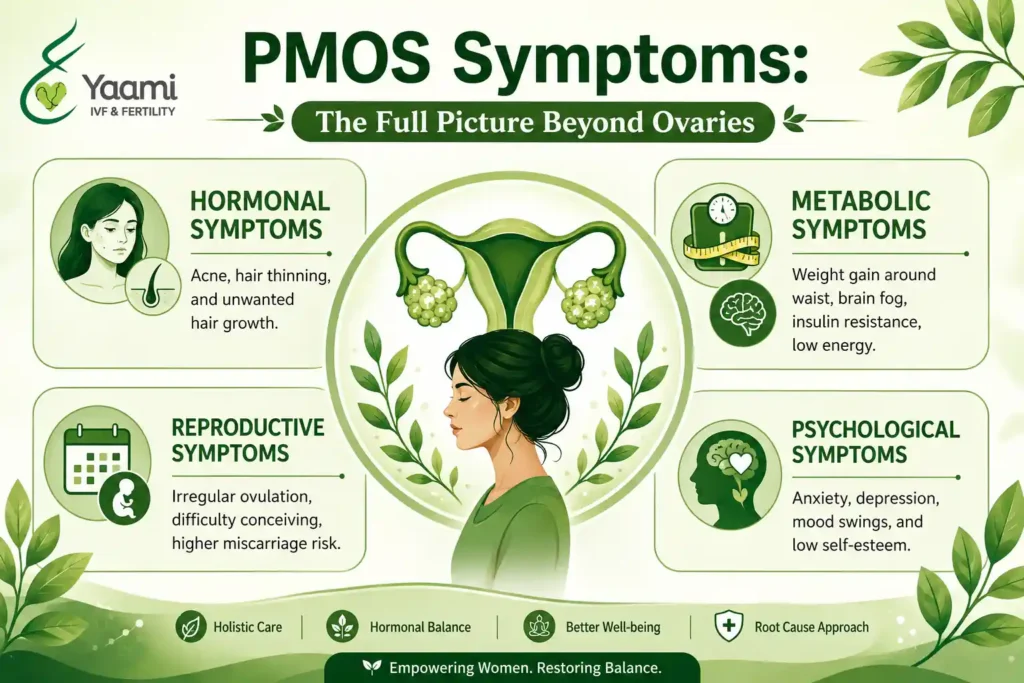
Under the PCOS label, many symptoms were dismissed and ignored, but the new name has changed that. So, let’s discuss the symptoms of PMOS:
- Hormonal Symptoms: You might experience persistent adult acne, thinning hair on the scalp, or unwanted hair growth on the face/body (hirsutism).
- Metabolic Symptoms: You might feel unexplained weight gain around the midsection, brain fog, insulin resistance, low energy and fatigue after meals.
- Reproductive Symptoms: You may face difficulty in conceiving, irregular ovualtion, or higher risk of miscarriage.
- Psychological Symptoms: You might experience anxiety depression, low self esteem and mood swings linked to hormonal fluctuations.
How PMOS Improves Diagnosis and Reduces Stigma
One of the most important outcomes of the PCOS renamed PMOS change is what it does for the diagnosis process and for how you feel about your condition.
Under the old name, you were told that you did not have PCOS simply because your ultrasound didn’t show cysts. With the shift to PCOS renamed PMOS 2026, the diagnosis is now more inclusive. Doctors now look at your blood tests and metabolic markers first. This reduces the stigma of ovarian disease and helps you understand that your symptoms are a result of a manageable metabolic shift.
PMOS Subtypes — A More Personalised Diagnosis
One of the most exciting directions in PMOS research is that you recognize distinct subtypes of the condition and it suggests there may be at least four presentations of PMOS:
- Androgen-dominant PMOS: This is the condition where high testosterone drives most of the symptoms in your body like acne, hair growth, irregular periods.
- Insulin-resistant PMOS: This is the condition where metabolic dysfunction is the primary issue in your body, often linked to weight gain and difficulty conceiving.
- Inflammatory PMOS: In this condition, you might experience low-grade chronic inflammation which is very difficult to manage.
- Mixed or complex PMOS: This is one of the worst conditions for your body where multiple factors overlap.
This type of division allows doctors to make a treatment plan that is actually tailored to your specific body type or condition.
PMOS Treatment in 2026: What’s New?
If you are already on a treatment plan for PCOS, it doesn’t become irrelevant overnight. The treatments remain largely the same, but the approach is becoming more comprehensive with various things including:
- Metabolic Restoration: Doctors here emphasize on using nutrition and specific supplements to help your cells respond to insulin and the betterment of the condition.
- Endocrine Support: Here, your doctor helps you with balancing the polyendocrine aspect through lifestyle, stress reduction, and overall care.
- Precision Medicine: in this treatment, doctors will use your specific subtype to decide whether you need lifestyle changes, medication, or advanced fertility support.
Conclusion
The PCOS Officially Renamed PMOS in 2026 change is not just a medical formality. It is the result of 14 years of research and decades of patients being told their symptoms were just hormones or not quite fitting the criteria.
PMOS (Polyendocrine Metabolic Ovarian Syndrome) finally explains that this is a complex, hormonal, metabolic disorder that affects your whole body, not just your ovaries. But do not worry, your old diagnosis is still valid, your symptoms are still real and the care you deserve is comprehensive, personalised, and informed which is becoming the new standard.
FAQ: PCOS Officially Renamed PMOS
Is my PCOS diagnosis still valid? Do I need a new test?
Yes, your diagnosis is still valid. You don’t need new tests, but your doctor might want to review your old results through the lens of PMOS to see if a different treatment subtype fits you better.
Does PMOS mean I can’t get pregnant?
Not at all. Many people with PMOS conceive naturally, and many more conceive with the right support and treatment. PMOS affects ovulation, which can make timing conception more challenging but it does not make pregnancy impossible.
What’s the difference between PCOS and PMOS?
PCOS (Polycystic Ovary Syndrome) and PMOS (Polyendocrine Metabolic Ovarian Syndrome) refer to the same underlying condition. PMOS is simply the new, more accurate name. The old name focused on ovarian cysts, which was misleading. The new name better reflects the hormonal and metabolic nature of the condition. For the next three years, both names are officially interchangeable.
Will my doctor in India use the new PMOS name?
The transition is happening globally throughout 2026. You may still hear both terms used interchangeably as clinics update their materials and protocols.
Where can I get PMOS / PCOS treatment in Indore?
If you are looking for personalized, research-backed care, Yaami IVF & Fertility Centre in Indore provides comprehensive support for PMOS and fertility. We focus on your total health to help you achieve your dream of parenthood.
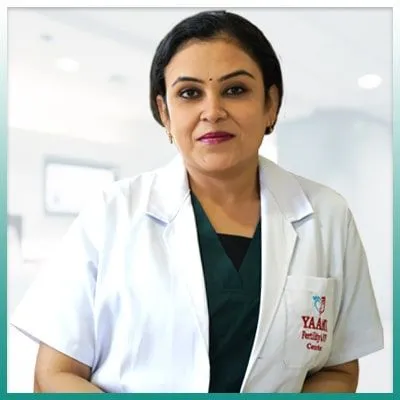
Dr. Swati Singh (MBBS, MD – Obstetrics & Gynecology, DNB, FRM, Diploma in Reproductive Medicine and Embryology – Germany) is a leading Infertility Specialist and Gynecologist with over 18 years of experience. As Co-Founder and Senior Consultant at Yaami Fertility & IVF Center, Indore, she offers advanced fertility care including IUI, IVF, ICSI, and management of female reproductive disorders. Known for her compassionate and patient-first approach, Dr. Swati combines global training with deep clinical expertise. She is also actively involved in women’s health advocacy, medical research, and promoting awareness about reproductive wellness and fertility treatments.