
Are you concerned about your fertility as you age?
Understanding your Antimüllerian Hormone (AMH) level is crucial. It reveals the eggs you have left, and surprisingly, some women with low AMH still experience regular periods.
According to a study by Fertility and Sterility, 13.9 % of women in the < 30 years age group and 26 % of women in the 31-35 year age group had AMH of < 1 ng/ml as compared to 2.6 % and 13.4 % respectively, in the control group. This study indicates the troubling trends of low AMH but regular periods in Indian women in the reproductive age group.
Despite the challenges low AMH levels present for natural conception, effective solutions exist. Assisted reproductive technologies like in vitro fertilization (IVF), ovarian stimulation, and donor eggs can significantly enhance your chances of conception.
Dr. Swati Singh, a top fertility expert at Yaami IVF Indore, is ready to guide you with expert advice and personalized care.
Trust Yaami IVF to navigate your fertility journey with the latest, most effective treatments, ensuring you have the best support, no matter your AMH level or age.
What is AMH?
AMH, a hormone made by the tiny follicles in your ovaries, is a top indicator of your ovarian reserve. That’s just a fancy term for how many eggs you’ve got left. It’s checked with a quick blood test that can be done anytime during your menstrual cycle.
What Are Normal AMH Levels?
Normal AMH Levels by Age:
| Age | AMH Level (ng/ml) | Interpretation |
|---|---|---|
| Under 33 | 2.1 – 6.8 | Normal |
| 33 – 37 | 1.7 – 3.5 | Normal for age |
| 38 – 40 | 1.1 – 3.0 | Low-normal |
| 41 – 43 | 0.5 – 2.5 | Low |
| Over 43 | 0.3 – 1.5 | Very low |
What is considered critically low AMH?
If your AMH is less than 0.5 ng/ml, your ovarian reserve is quite low. Levels below 1.0 ng/ml for women under 35 should trigger a visit to a fertility specialist. Dr. Swati Singh at Yaami Fertility takes a thorough approach by looking at AMH results in tandem with AFC ultrasounds and FSH levels.

Can You Have Low AMH and Regular Periods?
Yes, you can have low AMH levels and regular periods. Regular periods and your reserve of remaining eggs are actually managed by separate hormone systems. While FSH, LH, estrogen, and progesterone keep your periods ticking along, AMH is all about the quantity of your egg supply. So, it’s totally possible to get your periods regularly each month and have decent amounts of estrogen and progesterone, yet secretly have way fewer eggs than expected. Because of this disconnect, lots of women don’t realize their reserves are dwindling until they start trying for a baby or have a routine fertility check-up.
Can I Get Pregnant With Low AMH and Regular Periods?
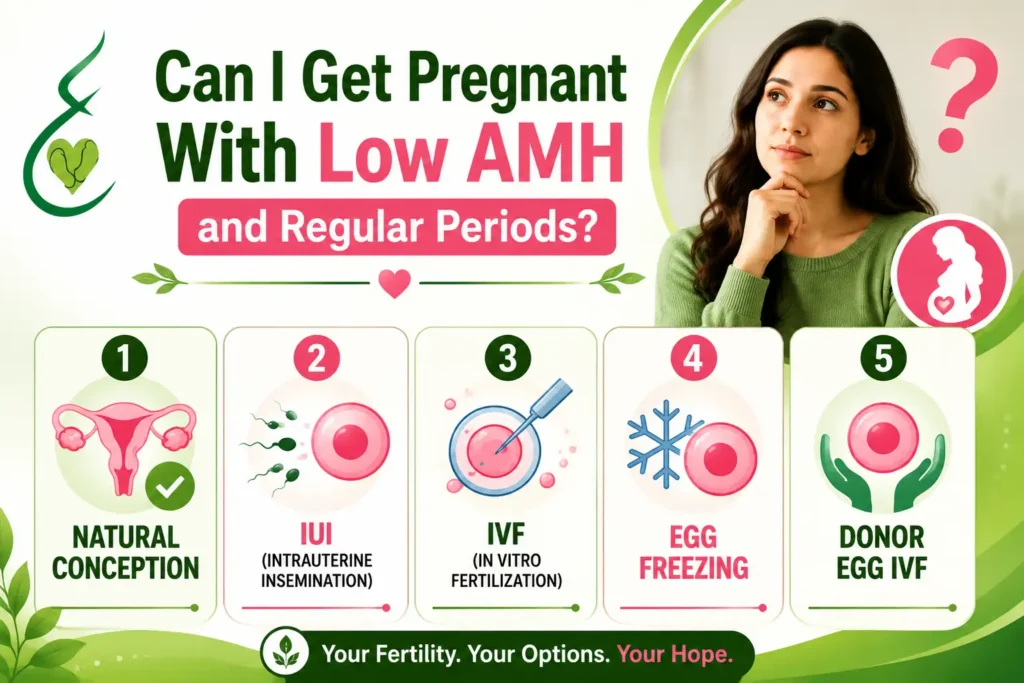
- Natural Conception: Women with low AMH but regular periods can still get pregnant naturally. It’s all about your age, AMH levels, and egg quality. If you don’t get pregnant within six months, see a fertility expert, especially if you’re over 35.
- IUI: For those under 35 with mildly low AMH, unblocked tubes, and who respond okay to stimulation, doctors might suggest intrauterine insemination (IUI).
- IVF: When that doesn’t work, in vitro fertilization (IVF) is your best shot. Dr. Swati Singh employs modified stimulation methods like the antagonist or mini IVF to boost egg retrieval for women with low AMH.
- Egg Freezing: If you aren’t planning to get pregnant yet, consider freezing your eggs as soon as you learn about the low AMH. The younger you are when you do this, the better the quality of your eggs and the more choices you’ll have later on.
- Donor Egg IVF: For really low AMH or if multiple IVF attempts haven’t worked, using donated eggs through IVF is an option that boasts about a 50 to 60 percent success rate per cycle. That’s currently one of the highest odds out there.
AMH Low Symptoms
Low AMH doesn’t show clear symptoms. A woman might discover it during a routine check-up or fertility test.
Despite having fewer eggs, she could still ovulate normally every month, so her periods are regular. This situation shows that fertility is complex and unique to each individual.
However, since AMH indicates a woman’s ovarian reserve, low levels can indirectly suggest certain conditions that may come with their own symptoms.
Here are some possible signs and broader implications associated with low AMH levels, particularly related to fertility:
- Reduced Fertility: The most direct implication of low AMH is a potentially reduced fertility rate. Women with low AMH may find it harder to conceive naturally due to a diminished number of available eggs.
- Irregular Menstrual Cycles: Although many women with low AMH levels might still have regular periods, some might start to experience irregular cycles as their ovarian reserve diminishes further.
- Earlier Menopause: Women with very low AMH levels are at a higher risk of experiencing premature menopause or earlier menopause than average. Symptoms leading up to menopause can include hot flashes, night sweats, mood changes, and vaginal dryness.
- Difficulty in IVF Success: In assisted reproductive technologies like IVF, low AMH might suggest a lower likelihood of retrieving a good number of healthy eggs, which can make the process more challenging.
Reasons for Low AMH But Regular Periods
Here are some clear reasons why AMH might be low even though menstrual cycles usually continue:
- Age: As women age, the number of eggs naturally decreases, as shown by lower AMH levels. However, many women will still have regular monthly periods despite fewer eggs.
- Genetics: Some women are genetically predisposed to have lower AMH levels. This doesn’t necessarily affect their menstrual cycle, which can remain regular due to other healthy reproductive functions.
- Early Ovarian Aging: In some cases, a woman’s ovaries might age faster than the rest of her reproductive system. This can cause AMH levels to drop while her periods stay regular, at least for a while.
- High Initial Egg Count: Women who start with many eggs might see their AMH levels drop but still have enough eggs to maintain regular periods.
- Environmental and Lifestyle Factors: Exposure to certain chemicals, smoking, or significant weight changes can impact AMH levels. These factors might lower AMH without immediately affecting menstrual regularity.
- Autoimmune Disorders: Certain autoimmune conditions can attack ovarian tissues, reducing AMH production. Interestingly, these conditions may not always affect the regularity of menstrual cycles.
How to Increase Low AMH?
If you’re concerned about low AMH levels—a key indicator of a woman’s remaining egg count—there are expert-approved strategies you can consider to enhance these levels.
- Healthy Diet: To support your reproductive system, focus on a diet rich in antioxidants. Include plenty of berries, nuts, green leafy vegetables, and whole grains.
- Vitamin and Mineral Supplements: Vitamin D, Coenzyme Q10, and Omega-3 fatty acids may improve ovarian function and AMH levels. Always consult with a healthcare provider before starting any new supplements.
- Regular Exercise: Engage in moderate, regular exercise to boost your overall health, which can, in turn, support reproductive function. Avoid overexertion, as it can be counterproductive.
- Manage Stress: Stress can adversely affect hormonal balance. Implement stress-reduction techniques such as yoga, meditation, and mindfulness practices.
- Avoid Smoking and Limit Alcohol: Smoking has a direct negative impact on ovarian reserve, and reducing alcohol consumption can also benefit your reproductive health.
- Herbal Remedies: Herbs like Maca root and DHEA can improve AMH levels. Discussing these options with your healthcare provider to ensure their safety and appropriateness is crucial.
- Consult a Fertility Specialist: A fertility specialist is highly recommended for personalized guidance and advanced treatment options. They can provide tailored advice based on your specific fertility profile.
Conclusion
Facing fertility issues due to low AMH levels might seem daunting, but with the right strategies, there are numerous options available.
Simple lifestyle adjustments, such as enhancing your diet and managing stress, along with advanced fertility treatments like in vitro fertilization (IVF) or ovarian stimulation, can significantly improve your chances of conception.
At Yaami IVF Indore, Dr Swati Singh and our supportive team are committed to providing straightforward, effective solutions and the support you need on your fertility journey.
We offer a range of personalised treatments tailored to meet your needs, helping you understand each option and choose the best path forward.
Visit us at Yaami IVF to discover how our expert care and welcoming environment can help you realize your dream of parenthood.
FAQs: Low AMH But Regular Periods?
Q1: Can I get pregnant with low AMH?
A: Yes, it is possible to get pregnant with low AMH levels. AMH indicates your ovarian reserve, not your fertility potential directly. Many women with low AMH successfully conceive using natural methods or through fertility treatments.
Q2: Is it possible to get pregnant with high AMH levels?
A: High AMH levels typically suggest a good ovarian reserve, a positive fertility indicator.
However, very high AMH levels can sometimes be associated with conditions like polycystic ovary syndrome (PCOS), which might complicate conception.
Managing these conditions with appropriate medical guidance can improve your chances of pregnancy.

Dr. Swati Singh (MBBS, MD – Obstetrics & Gynecology, DNB, FRM, Diploma in Reproductive Medicine and Embryology – Germany) is a leading Infertility Specialist and Gynecologist with over 18 years of experience. As Co-Founder and Senior Consultant at Yaami Fertility & IVF Center, Indore, she offers advanced fertility care including IUI, IVF, ICSI, and management of female reproductive disorders. Known for her compassionate and patient-first approach, Dr. Swati combines global training with deep clinical expertise. She is also actively involved in women’s health advocacy, medical research, and promoting awareness about reproductive wellness and fertility treatments.