

The USG is a safe, non-invasive imaging test that uses high-frequency sound waves to create real-time pictures of the organs and tissues inside your body. The USG full form is Ultrasonography. In USG, doctors do not use any radiation, making it completely safe for all age groups, including pregnant women and unborn babies. In pregnancy, a USG scan is one of the most important tools used to monitor the growth of the baby, check the position of the placenta, detect any complications, and confirm the overall health of both the mother and the child. USG scans are also widely used to evaluate the uterus, ovaries, kidneys, liver, and other organs, making it one of the most versatile diagnostic tools in modern medicine.
The moment you see a prescription with “USG” written on it, you wonder why your doctor has just recommended you get it done, and you get a lot of questions in your mind, like why do I need it? And what exactly is this?
USG (ultrasound) is a safe, non-invasive imaging technique that uses high-frequency sound waves to produce real-time pictures or videos of organs inside your body.
But you don’t have to overthink about it because many women encounter this term when they go through problems related to reproductive health or during their pregnancy.
According to Dr. Swati Singh (Reproductive Medicine), MBBS, MD, DNB, FRM, DRM (Germany) at Yaami IVF and Fertility Centre, Indore, USG plays an important role in pregnancy by giving information about the fetus, heartbeat, or amniotic fluid levels. It helps the doctor to decide on necessary precautions or treatment to ensure a healthy baby.
Now, to understand more about USG, the USG full form, its uses, its procedure, its advantages, and its limitations, read this blog till the end.
What Is the USG Full Form?
This is the most commonly asked question by people: What is USG scan full form?
The USG test full form is Ultrasonography & it remains the same across all medical fields, whether it is used for checking your liver, your uterus, your heart, or your baby during pregnancy.

What Is USG? (Understanding Ultrasound)
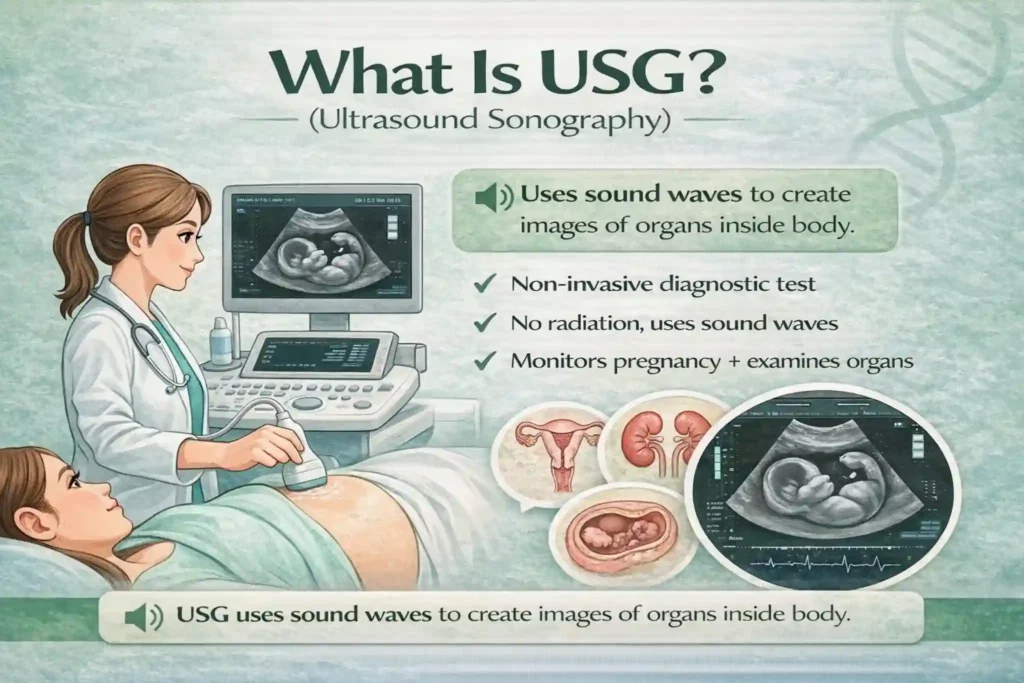
USG means ultrasound or ultrasonography. This is a non-invasive imaging technique that uses high-frequency sound waves to create real-time images of your internal body organs. This is one of the most common tools used for checking the health of your kidney, gallbladder, or liver, and is mostly used in pregnancy to track the baby’s growth.
Types of USG Scans
Depending on what your doctor needs to examine, there are different kinds of USG scans, like pelvic USG, pregnancy USG, and abdominal USG, etc.
Let’s understand each one of them in detail:
- Abdominal USG
This is the most familiar type of USG, where a gel is applied to your abdomen, and a transducer is gently moved across your skin. The doctor can see your kidneys, gallbladder, and other abdominal organs clearly.
It is commonly recommended by your doctors for abdominal pain, bloating, nausea, suspected stones, or any other digestive concern.
- Pelvic USG
A pelvic USG is performed for the lower abdomen, specifically the uterus, ovaries, fallopian tubes, and urinary bladder. Your doctor may recommend this USG when you deal with irregular periods, pelvic pain, suspected cysts, fibroids, or difficulty conceiving.
- Pregnancy USG
USG in pregnancy is called pregnancy USG. It is a safe, non-invasive diagnostic test that your doctors use to monitor fetal growth, confirm pregnancy, and check potential developmental issues.
- Transvaginal USG
The transvaginal USG is often performed to confirm pregnancy as early as 5–6 weeks or to evaluate early concerns like spotting. This USG is the most reliable way to ensure the embryo has implanted correctly inside the uterus rather than in the fallopian tubes.
- Doppler USG
Doppler USG identifies conditions like blood clots, vascular disease, and heart valve defects. And in case of pregnancy, a Doppler USG is a specialised tool used to evaluate the blood flow between you and your baby.
Why Is USG Done? (Uses of USG)
The USG can be suggested by a doctor for both men and women. But conditions can vary in different cases, such as detecting kidney stones, checking if there are any fibroids or cysts in the uterus, confirming pregnancy, or detecting male fertility, etc.
Let’s understand each one of them in detail:
- In General Medical Issues:
- It helps your doctors detect kidney stones, gallstones, or liver problems.
- It helps your doctors identify tumors or abnormal masses.
- It helps your doctors guiding needle during biopsies or fluid aspiration.
- In Gynecology and Female Fertility:
- It helps your fertility expert to find out if the uterus has fibroids, polyps, or structural issues.
- It helps your doctor check your ovaries for PCOS or cysts.
- It helps your doctor monitor follicle growth during fertility treatments.
- It helps your doctor evaluate the endometrial (uterine) lining thickness.
- In Pregnancy (USG full form in pregnancy):
- It helps your doctor to confirm pregnancy and calculate the due date.
- It helps your fertility expert to screen chromosomal abnormalities.
- It helps your doctor monitor the baby’s growth, position, and amniotic fluid.
- It helps the doctor to detect your placenta previa or other pregnancy complications.
- In Male Fertility:
- It helps your doctor to assess testicle health and detect varicocele.
- It helps your doctor to identify blockages in the reproductive tract.
USG Scan Procedure
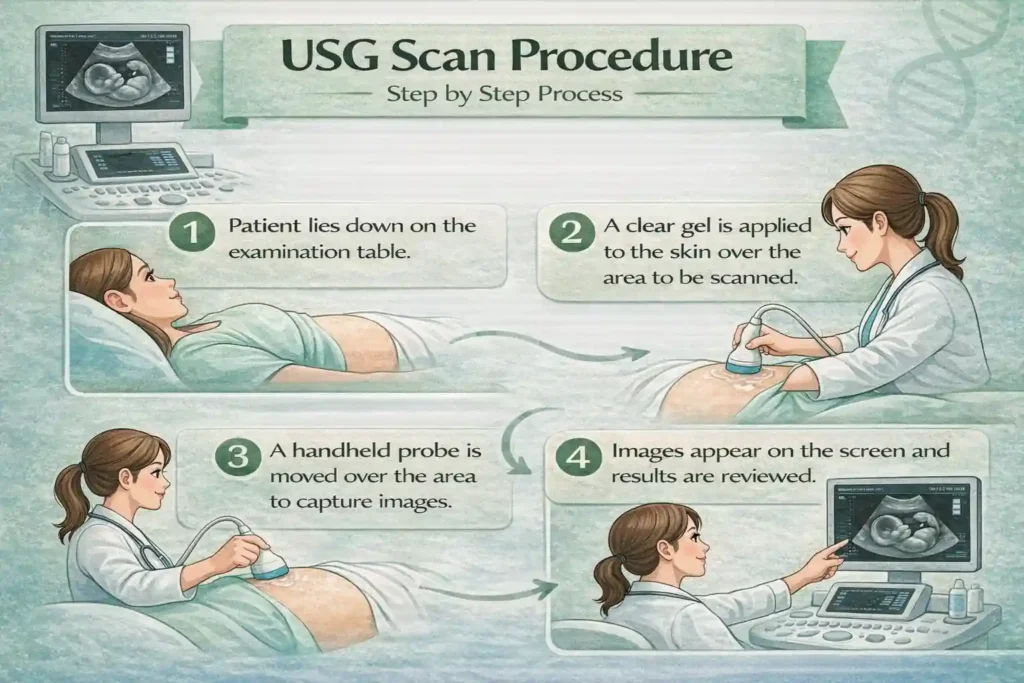
USG scan is an easy process that takes almost 15-20 minutes. You can read the steps mentioned below to better understand the USG scan procedure:
- Before the scan: Depending on the type of USG, you will be asked to drink water and keep your bladder full (for pelvic or abdominal scans) or fast for a few hours (for abdominal scans). Your doctor will tell you specifically what to do beforehand.
- During the scan: You will lie down on a table, and a clear, water-based gel will be applied to the area being scanned. Then the sonographer or radiologist will gently press the transducer against your skin and move it around to capture images of your organs inside. The entire procedure usually takes between 15 to 20 minutes.
- During a transvaginal USG: A thin probe, covered with a protective sheath and gel, is gently inserted into your vagina. You remain lying down throughout, and the process is usually done within 10–15 minutes.
- After the scan: When all the images are captured in the scan, your sonologist will wipe off the gel, and you can live your day normally. There is no recovery time needed.
How to Read a USG Report
When you get the USG report, you may find some unfamiliar terms that are hard to understand.
Let’s understand with the help of this table what your (pelvic or pregnancy) report says:
| Terms | What It Means |
| Uterus – Anteverted/ Retroverted | The position of your uterus. Both can be normal. |
| Endometrial thickness | The thickness of the uterine lining in millimetres. |
| Ovarian cyst | A fluid-filled sac in the ovary. |
| Follicle / AFC | Egg-containing sacs in the ovary. Important in fertility. |
| CRL | Crown-Rump Length is used to estimate a baby’s gestational age. |
| BPD | Biparietal Diameter is the width of the baby’s head. |
| AFI | The Amniotic Fluid Index is the level of fluid around the baby. |
| FHR | Fetal Heart Rate is the baby’s heartbeat per minute. |
| No significant anomaly detected | A reassuring phrase meaning no major issues were found. |
You need to remember that a USG report is always read in context with your symptoms and medical history. Do not try to interpret it alone. Always discuss it with your fertility specialist.
Advantages and Limitations of USG
USG is a highly versatile imaging tool, but it has some advantages and limitations. Let’s understand them in detail:
Advantages:
- Completely safe: USG has no radiation, so it is the safest option for monitoring pregnancy.
- Real-time imaging: With the help of the USG report, doctors can see the organ movement and the beating heart of a fetus.
- Widely accessible: USG scan is more affordable and more widely available for you than MRI or CT scans.
- No preparation required: Unlike surgery, USG requires no invasive preparation, though you may need a full bladder or a period of fasting depending on the area being scanned.
- Suitable for all ages: USG scans are safe and suitable for everyone, such as men, women, kids, or in pregnancy.
Limitations:
- Difficulty with Bone & Air: Ultrasound waves cannot easily penetrate bone or pass through air/gas. This makes it less effective for viewing inside the skull, lungs, or structures hidden behind intestinal gas.
- Dependent on the operator: USG scans are mostly operator-dependent, which means the quality of findings depends on the skill and experience of the person performing the scan.
- Not always detectable: It cannot detect very small abnormalities or early-stage cancers with certainty.
- Limited field of view: Along with USG scans, you may need tests like MRI, CT scan, or blood test for a complete diagnosis.
Conclusion
Ultrasonography is one of the safest, most reliable, and most widely used diagnostic tests used by doctors.
Whether you are trying to understand your body, tracking your fertility, or keeping a close watch of your baby’s health, a USG scan gives your doctor a clear, real-time view without putting you through any discomfort or risk.
And if you have completed the USG scanning and received the report, but now you do not understand your situation, or if your doctor has recommended other scans as a part of your fertility checkup, then you do not have to figure it out alone.
Our fertility experts at Yaami IVF & Fertility Centre, Indore, will guide you in every step and provide you with the best treatment and guidance required, depending on your situation.When you are ready, our team at Yaami IVF & Fertility Centre is here to walk with you every step of the way. You can reach us at 7880007281 to book a consultation.
FAQ: USG & USG full form
Does USG Produce Radiation?
No. USG does not produce any radiation. It uses high-frequency sound waves to create images, making it completely safe for pregnant women, babies, and people of all ages.
Is USG a Painful Test?
In most cases, a USG is completely painless. You may feel mild pressure when the transducer is moved across your skin.
Is USG the Same as Sonography?
Yes, USG and sonography refer to the same test. Sonography is the common term used in everyday conversation, while USG (Ultrasonography) is the more formal medical term.
How Many Times Can USG Be Done Safely?
Since there is no radiation, there is no strict limit. Your doctor will schedule them only when medically necessary for your care.
Can USG Detect All Diseases?
No, USG cannot detect all diseases. It is very effective for evaluating soft tissues, organs, blood flow, and pregnancy. However, it is not ideal for examining bones, air-filled organs, or very small abnormalities.
Is USG Harmful During Pregnancy?
Absolutely not. In fact, it is the safest way to monitor your baby’s health and has been used for decades without any evidence of harm to the mother or child.

Dr. Swati Singh (MBBS, MD – Obstetrics & Gynecology, DNB, FRM, Diploma in Reproductive Medicine and Embryology – Germany) is a leading Infertility Specialist and Gynecologist with over 18 years of experience. As Co-Founder and Senior Consultant at Yaami Fertility & IVF Center, Indore, she offers advanced fertility care including IUI, IVF, ICSI, and management of female reproductive disorders. Known for her compassionate and patient-first approach, Dr. Swati combines global training with deep clinical expertise. She is also actively involved in women’s health advocacy, medical research, and promoting awareness about reproductive wellness and fertility treatments.