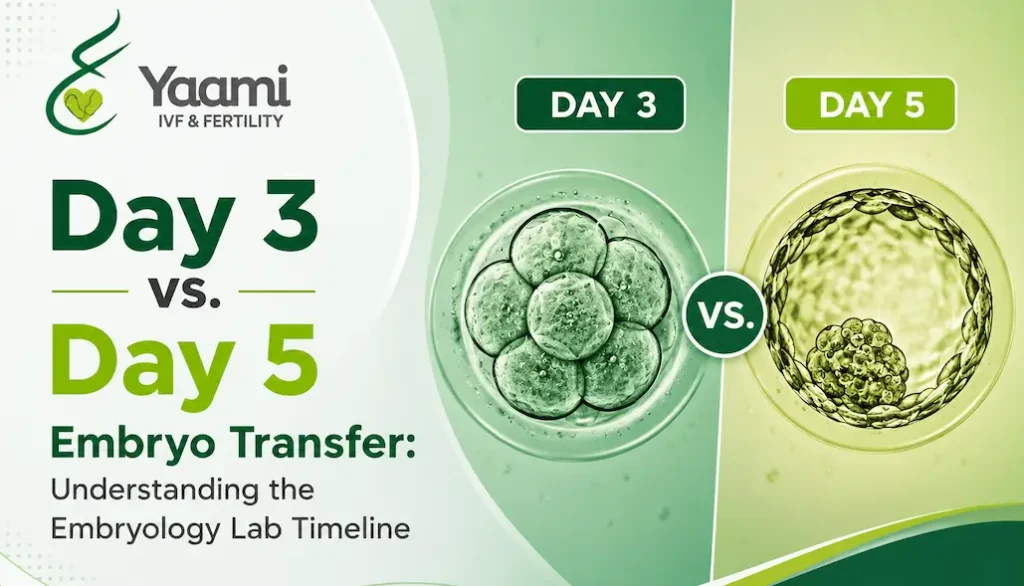
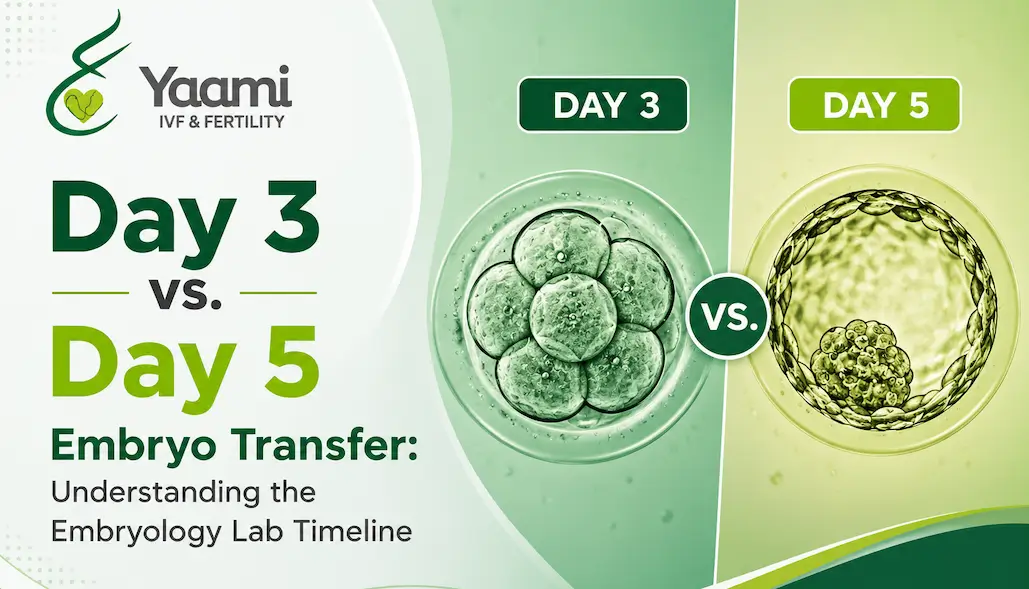
Day 3 vs. Day 5 Embryo Transfer? Well this depends on embryo development, embryo quality, and individual fertility factors. As Day 3 transfer involves a cleavage-stage embryo, while a Day 5 transfer uses a more developed blastocyst that provides additional information about implantation potential. Neither option is universally better. Fertility specialists choose the transfer timing based on factors such as age, number of embryos available, previous IVF history, and overall treatment goals to maximize the chances of a successful pregnancy.
Should you transfer your embryo on Day 3 or wait until Day 5? If you’re going through IVF treatment, this question can feel overwhelming.
After all you have already invested emotionally, physically, and financially, you naturally want to choose the option that gives you the best possible chance of success.
Dr. Swati Singh (Reproductive Medicine Specialist, MBBS, MD, DNB, FRM, DRM) at Yaami IVF & Fertility Centre, Indore, explains that the choice between Day 3 vs Day 5 embryo transfer is not about finding a universally better option. It is about understanding which approach is most suitable for your unique fertility journey.
Let’s walk through this blog to gain a deeper understanding about how embryos develop and why transfer timing matters.
What is a Cleavage Stage (Day 3) Embryo?
After an egg is fertilized by a sperm in the IVF laboratory, it begins dividing into multiple cells.
By Day 3, the embryo typically contains around 6 to 10 cells. At this point, it is known as a cleavage stage embryo.
During these first few days, embryologists carefully monitor the embryo’s development inside specialized incubators (a machine used in hospitals for keeping small or weak babies alive in controlled conditions ) that copy the conditions of the human body.

A healthy cleavage stage embryo usually shows:
- Proper cell division
- Minimal cell fragmentation
- Even-sized cells
- Consistent growth patterns
Historically, many IVF clinics performed embryo transfers on Day 3 because laboratory culture systems were less advanced. However, improvements in embryology laboratories have made it possible to grow embryos for longer periods before transfer.
This naturally brings us to the next stage of embryo development.
What is a Blastocyst (Day 5) Embryo?
If an embryo continues developing successfully after Day 3, it reaches the blastocyst stage by Day 5 or Day 6.
A blastocyst contains hundreds of cells and develops into a more complex structure.
At this stage, the embryo contains:
- An inner cell mass (which eventually becomes the baby)
- A fluid-filled cavity
- An outer layer called the trophectoderm (which later helps form the placenta)
The blastocyst stage is considered an important milestone because only embryos with strong developmental potential are usually able to reach this stage.
This is why many fertility specialists believe that Day 5 embryos may provide additional information about embryo quality.
However, this does not automatically mean that every patient should wait until Day 5.
To understand why, it’s helpful to compare both approaches side by side.
The Core Differences: Day 3 vs. Day 5 Embryo Transfer
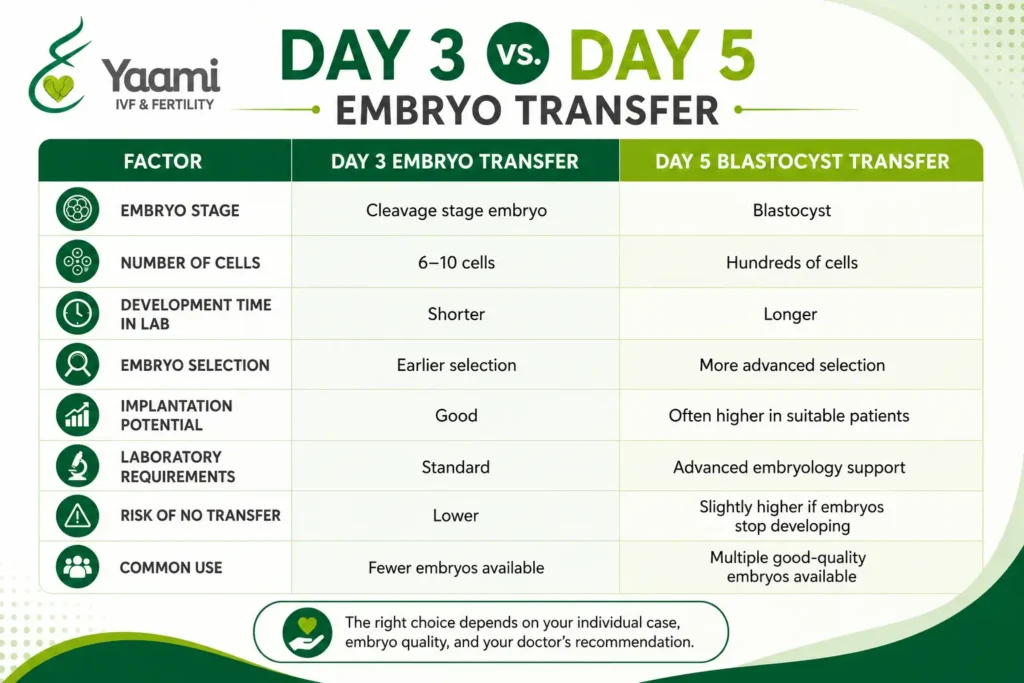
When discussing Day 3 vs Day 5 embryo transfer, the main difference lies in how long the embryo is allowed to develop inside the embryology laboratory before transfer.
Let’s understand it with the help of a table.
| Factor | Day 3 Embryo Transfer | Day 5 Blastocyst Transfer |
| Embryo Stage | Cleavage stage embryo | Blastocyst |
| Number of Cells | 6–10 cells | Hundreds of cells |
| Development Time in Lab | Shorter | Longer |
| Embryo Selection | Earlier selection | More advanced selection |
| Implantation Potential | Good | Often higher in suitable patients |
| Laboratory Requirements | Standard | Advanced embryology support |
| Risk of No Transfer | Lower | Slightly higher if embryos stop developing |
| Common Use | Fewer embryos available | Multiple good-quality embryos available |
Looking at this comparison, many patients assume that Day 5 transfer is always better.
However, fertility treatment is rarely that simple. Several individual factors influence the decision.
Why Do Doctors Choose One Over the Other?
One of the most common misconceptions/myth in IVF is that every patient should receive a Day 5 transfer.
In reality, fertility specialists customize the treatment plans based on each patient’s situation.
1. Maternal Age
Age is one of the most important factors affecting embryo quality.
Younger patients often produce a larger number of healthy embryos, making extended culture to Day 5 more practical.
For older patients, doctors carefully evaluate whether continuing embryo culture provides an advantage or whether an earlier transfer may be more appropriate.
However, age is only one part of the picture.
2. Number of Embryos Available
The number of embryos available after fertilization can significantly influence transfer timing.
If several good-quality embryos are developing, doctors may prefer to continue culture until Day 5.
This allows embryologists to observe which embryos continue growing successfully.
On the other hand, if only a small number of embryos are available, some clinics may recommend transferring earlier rather than risking developmental arrest in the laboratory.
This decision is highly individualized and depends on the patient’s circumstances.
3. Previous IVF Cycle History
Previous treatment history also plays an important role.
For example:
- Previous implantation failures
- Previous miscarriages
- Earlier unsuccessful transfers
- Embryo development patterns
These factors may influence whether a specialist recommends Day 3 or Day 5 transfer in future cycles.
This is why experienced fertility teams evaluate the complete clinical picture rather than following a one-size-fits-all approach.
Now that we understand the decision-making process, let’s address the question in which most couples are interested in.
Which Option Delivers Higher Success Rates?
After understanding the differences between a cleavage stage embryo and a blastocyst, the most important thing to remember is that IVF success is not just about choosing Day 3 or Day 5. It is about choosing the right strategy for your specific situation.
In many cases, Day 5 transfer may be preferred when:
- Multiple good-quality embryos are available
- Embryos are developing well in the laboratory
- Additional embryo selection is beneficial
- Previous IVF cycles have shown good embryo development
Day 3 transfer may still be a good option when:
- Only a few embryos are available
- The doctor wants to avoid prolonged culture
- Previous cycle history suggests earlier transfer may be beneficial
The Key Takeaway
| Situation | Often Preferred |
| More embryos available | Day 5 Transfer |
| Fewer embryos available | Day 3 Transfer |
| Strong embryo development | Day 5 Transfer |
| Individualized clinical reasons | Day 3 or Day 5 |
As Dr. Swati Singh often explains, the highest success rates come from personalized treatment decisions, not from following a single approach for every patient. The goal is always to transfer the embryo at the stage that offers you the best possible chance of achieving a healthy pregnancy.
Conclusion
Understanding Day 3 vs Day 5 embryo transfer can help you feel more informed during your IVF journey. While a cleavage stage embryo on Day 3 represents an earlier stage of development, as Day 5 blastocyst has undergone additional growth that may provide more information about its implantation potential.
At Yaami IVF & Fertility Centre, Indore, every embryo transfer decision is made after carefully evaluating your unique fertility profile. Our experienced fertility specialists and advanced embryology laboratory work together to select the most appropriate treatment strategy for each patient.
If you’re planning IVF treatment in indore or have questions about embryo development and transfer timing, the team at Yaami IVF & Fertility Centre is here to guide you with expert care, transparency, and personalized support at every step of your parenthood journey.
FAQ
Is a Day 5 transfer always better than a Day 3 transfer?
Not necessarily. While Day 5 blastocysts generally have a higher implantation success rate per embryo, some embryos thrive better inside the natural environment of the maternal uterus than in a laboratory incubator. For patients with fewer embryos, a Day 3 transfer is often preferred to avoid the risk of embryos arresting in the lab.
What causes an embryo to fail to grow from Day 3 to Day 5?
Up until Day 3, an embryo relies mostly on the mother’s egg quality for energy. Between Day 3 and Day 5, the embryonic genome activates, meaning the father’s sperm quality and the combined genetic blueprint take over.
Can you do genetic testing (PGT) on a Day 3 embryo?
While physically possible (cleavage-stage biopsy), modern clinics rarely perform it because removing a cell on Day 3 takes away 12.5% of the embryo’s entire mass, which can severely compromise its survival. Genetic testing is significantly safer and more accurate when performed on Day 5 or Day 6 blastocysts.

Dr. Swati Singh (MBBS, MD – Obstetrics & Gynecology, DNB, FRM, Diploma in Reproductive Medicine and Embryology – Germany) is a leading Infertility Specialist and Gynecologist with over 18 years of experience. As Co-Founder and Senior Consultant at Yaami Fertility & IVF Center, Indore, she offers advanced fertility care including IUI, IVF, ICSI, and management of female reproductive disorders. Known for her compassionate and patient-first approach, Dr. Swati combines global training with deep clinical expertise. She is also actively involved in women’s health advocacy, medical research, and promoting awareness about reproductive wellness and fertility treatments.